

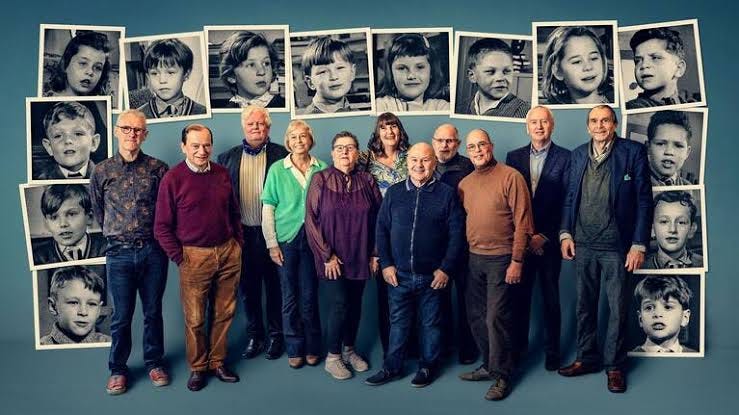
Watching ‘70 Up’ is like opening a family photo album belonging to an entire country.
The film is part of the extraordinary ‘Up’ series, which began in 1964 by following fourteen seven-year-old children from very different backgrounds. Every seven years, the cameras returned to ask the same questions: What do you want to be? What kind of life do you expect? Are you happy?
At first, the experiment seems to be about predicting the future. By the time we reach ‘70 Up’, however, prediction matters much less than reflection. These are no longer children imagining adulthood. They are older people looking back at the lives they have actually lived - and at the choices, opportunities and limitations that shaped them.
The biggest lesson is that a person’s life cannot be reduced to a beginning, a career or a single decision.
Education shapes more than employment
One of the clearest themes throughout the series is the unequal power of education. The children who attended private schools were often given expectations that extended far beyond their immediate circumstances. University, professional careers and leadership seemed possible because the adults around them assumed they were possible. Other children, despite having intelligence and ambition, were encouraged to aim lower - or were never given the same opportunities in the first place.
This does not mean that education determines everything. The series is too human and too complicated for that. Some people defy expectations, while others struggle despite having every apparent advantage. But education changes the boundaries of what a person can imagine. It is not only about knowledge, qualifications or getting a job. It is also about confidence: the sense that you belong in certain rooms, that your opinion matters, that you are entitled to ask questions and pursue a larger life.
That is why education should never be treated as a privilege reserved for those who already appear promising. Often, a student’s potential becomes visible only after someone believes in them.
Early circumstances have an impact, but they are not destiny
The participants’ childhoods clearly influence them. Family income, social class, location, health and access to education all leave their mark. Yet the series also challenges the idea that childhood completely determines adulthood. People change. They make unexpected choices. They experience loss, love, illness, disappointment and renewal. Some reject the values they grew up with; others return to them. Several participants follow paths that would have seemed unlikely when they were seven. This has made me think differently about the labels we place on children. A child may be described as shy, difficult, academic, unmotivated or disruptive. But ‘70 Up’ reminds us that these are snapshots, not verdicts. A seven-year-old is not a finished person. Neither is a seventeen-year-old—or, for that matter, a forty-year-old. Education should leave room for reinvention. People need the opportunity to become someone their younger selves could not yet imagine.
Success is not one thing
When the participants were young, success was often discussed in conventional terms: a good career, financial security, marriage, status or professional achievement. By seventy, those measures have become far less convincing.
Some people who appeared destined for impressive careers are not necessarily the happiest. Others who seemed less successful by traditional standards have built rich, meaningful lives through family, friendship, creativity, work or service. The series does not offer a simple formula for happiness. Instead, it shows how misleading it can be to judge a life from the outside…A person can have an impressive job and feel lost. Someone else can live quietly and feel deeply content. A life that looks ordinary may contain enormous courage.
This is an important lesson for education, because schools can unintentionally teach students to measure themselves against a narrow definition of achievement. Grades, university places and salaries are absolutely important, but they are not the whole story. Education should also help people discover what they value and what kind of life they want to build.
Relationships are part of the curriculum
One of the most moving aspects of ‘70 Up’ is the attention given to relationships.
The participants speak about parents, partners, children, friends and the people they have lost. Their lives are shaped not only by what they achieved, but by who stood beside them and who did not.
This suggests that emotional education is just as important as academic education. We need to learn how to communicate, apologise, listen, set boundaries and cope with change. We need to understand ourselves well enough to choose relationships that are healthy and sustaining. These skills are rarely measured in exams, but they may determine the quality of our lives more profoundly than many academic accomplishments.
Time changes the meaning of everything
Watching the series across decades also changes the way I think about time. A decision that seems disastrous at twenty may look different at fifty. A disappointment may lead to an opportunity and a success may create pressures no one could have anticipated. People who appear certain in one episode may be questioning themselves in the next.
Life is not a straight line. It is a collection of chapters, and the meaning of one chapter often becomes clear only much later. That is comforting when life feels confusing. It suggests that we do not need to understand everything immediately. Not every setback is a permanent failure, and not every achievement guarantees lasting happiness. We are all works in progress.
The privilege of being seen
There is something powerful about the participants returning to the programme every seven years. The interviews can be uncomfortable, but they also create a rare record of people being asked to pause and take stock. Most of us do not have a film crew documenting our lives. We move from one responsibility to the next without being asked what has changed, what we regret or what we now understand. Perhaps we should create our own moments of reflection. Every few years, it may be worth asking:
What do I value now?
What have I outgrown?
Who has helped me?
What am I still avoiding?
What kind of person am I becoming?
The answers will change but perhaps that is the point.
The lesson I keep returning to
The deepest lesson of ‘70 Up’ is that a life is both shaped and surprising. We are influenced by where we begin, but we are not only our beginnings. Education opens doors, but wisdom often comes from experiences no classroom can provide. Success matters, but love, resilience and meaning matter more. Time takes things away, but it also gives us perspective.
Most of all, the series encourages humility. We should be cautious about judging other people’s lives (and our own) too early. At seven, we are still becoming. At seventy, we are still becoming. And perhaps that is the most hopeful lesson of all.
Now excuse me while I have a little weep that it's all over.