Teacher development for retention: grow the conditions, not just the teacher

Schools often treat teacher development as something delivered to teachers:
A twilight session.
A coaching cycle.
A training day.
A folder of resources.
A new framework.
A mentor meeting.
Some of these are useful, but none of them, alone, explain why teachers stay.
The research on retention points to something bigger. Teachers stay when they are rooted in a school: connected to colleagues, trusted by leaders, able to grow, resourced to do the job well, and able to imagine a future there. Development is not separate from retention. It is one of the main ways schools create reasons to stay. This is what Sam Gibbs and I uncovered in our upcoming book, ‘Love the One You’re With,’ available to preorder here.
It has made me start thinking about a different model of teacher development…one which thinks more holistically than steamrollering the complexity out of teacher development, into a neat series of ‘learn that’ and ‘learn how to’ statements.
In my head, I have been visualising this as a ‘Teacher Development Garden’ as a useful metaphor for what developing teachers should look like. It moves us away from thinking about CPD as a ladder, where every teacher climbs the same route, and more towards an ecosystem. Teachers do not grow simply because someone tells them to. They grow when the conditions around them make growth possible.
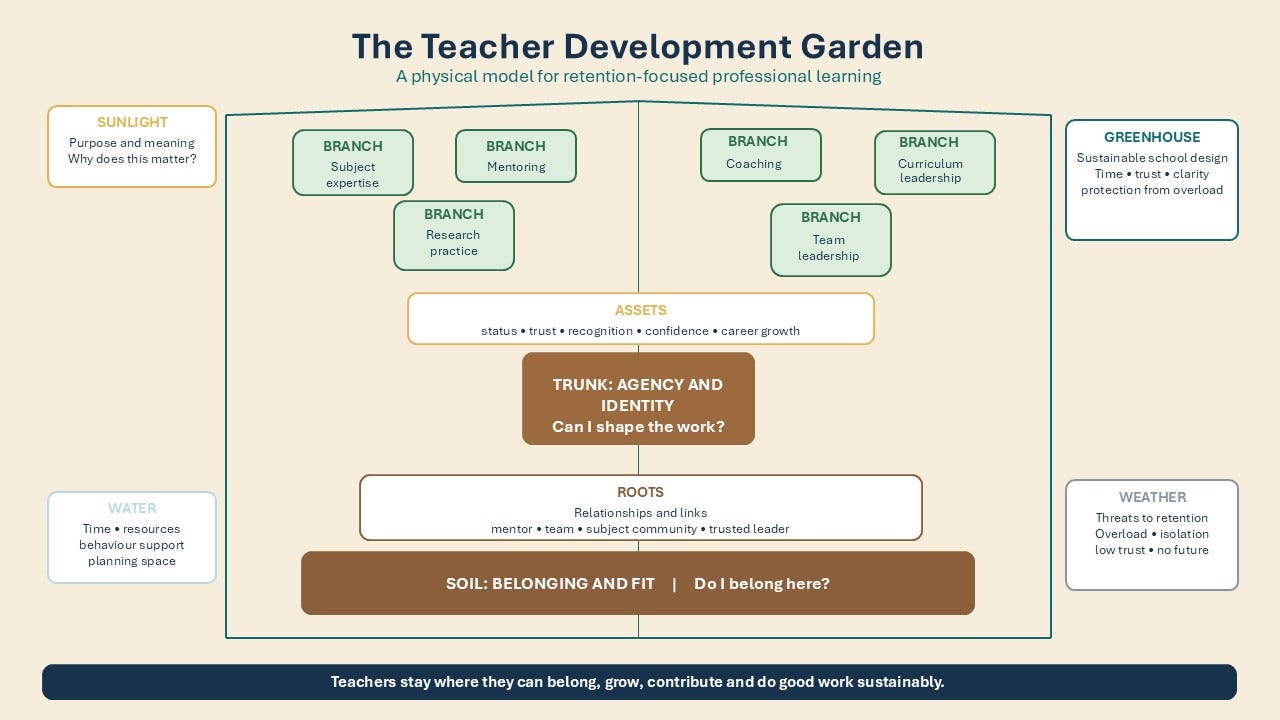
The soil is belonging and fit. This is the foundation. Teachers need to feel that they belong in the school and that their values connect with the work. New staff need more than an induction checklist. They need to be known. They need to understand the school’s purpose. They need to see how their subject, identity and strengths matter. Without good soil, development does not take root. Belonging is not a one size fits all. I often despair when people talk about top-down, highly centralised multiacademy trusts as horrific, claiming they wouldn’t want to work there. Yet, you often speak to teachers at trusts like this and they love it. That is the thing about belonging - there is a school for everyone.
The roots are relationships and links. Teachers are more likely to stay when they are connected to people who help them survive and improve: mentors, subject teams, trusted leaders, peer networks, coaching partners and professional friends. Isolation is dangerous. A teacher left alone behind a classroom door may cope for a while, but coping is not the same as staying well. Strong roots mean no teacher grows alone.
The trunk is agency and professional identity. Teachers need to shape the work, not just receive it. Agency does not mean everyone doing whatever they want. It means teachers have meaningful influence within a shared direction. They can adapt approaches intelligently, contribute to curriculum decisions, help design CPD, and exercise judgement. When teachers are treated only as implementers, development becomes compliance. When they are treated as thinkers, development becomes professional growth.
The branches are expertise pathways. Not every teacher wants the same future. Some want to become subject experts. Some want to mentor. Some want to coach. Some want to lead curriculum, assessment, pastoral work, SEND, research or teams. A good development model makes several futures possible without forcing talented teachers out of the classroom. Teachers stay when staying gives them a future.
The sunlight is purpose and meaning. Development must answer the question: why does this matter? If CPD is disconnected from pupils, subjects and moral purpose, it becomes noise. Teachers are more motivated when they can see how professional learning helps them teach better, reduce wasted effort, improve pupils’ experience and become the kind of teacher they want to be.
The water is resources and conditions. No amount of motivation can compensate for dry ground. Teachers need time, materials, planning space, behaviour support, sensible systems and access to specialist help. A school cannot claim to invest in development while leaving teachers without the conditions to use what they are learning. CPD without time becomes extra work. Coaching without workload protection becomes pressure.
The greenhouse is sustainable school design. This is the wider climate created by leaders and trusts. It includes workload, meeting rhythms, trust, clarity, staffing models, induction, collaboration and accountability. The greenhouse does not grow the plant directly, but it shapes whether growth can continue. Retention is not a wellbeing poster. It is the design of the working environment.
The pruning is feedback and coaching. Development needs challenge. Teachers need precise feedback, rehearsal, coaching and opportunities to refine practice. But pruning only helps if the plant is healthy enough to grow. Coaching in a culture of overload or fear can feel like surveillance. Coaching in a culture of trust becomes a route to expertise.
Outside the greenhouse is the weather: workload, low trust, weak support, initiative overload, isolation, poor behaviour systems and limited progression. These are not minor inconveniences. They damage growth. If leaders ignore the weather, they may blame teachers for failing to thrive in conditions that were never designed for them.
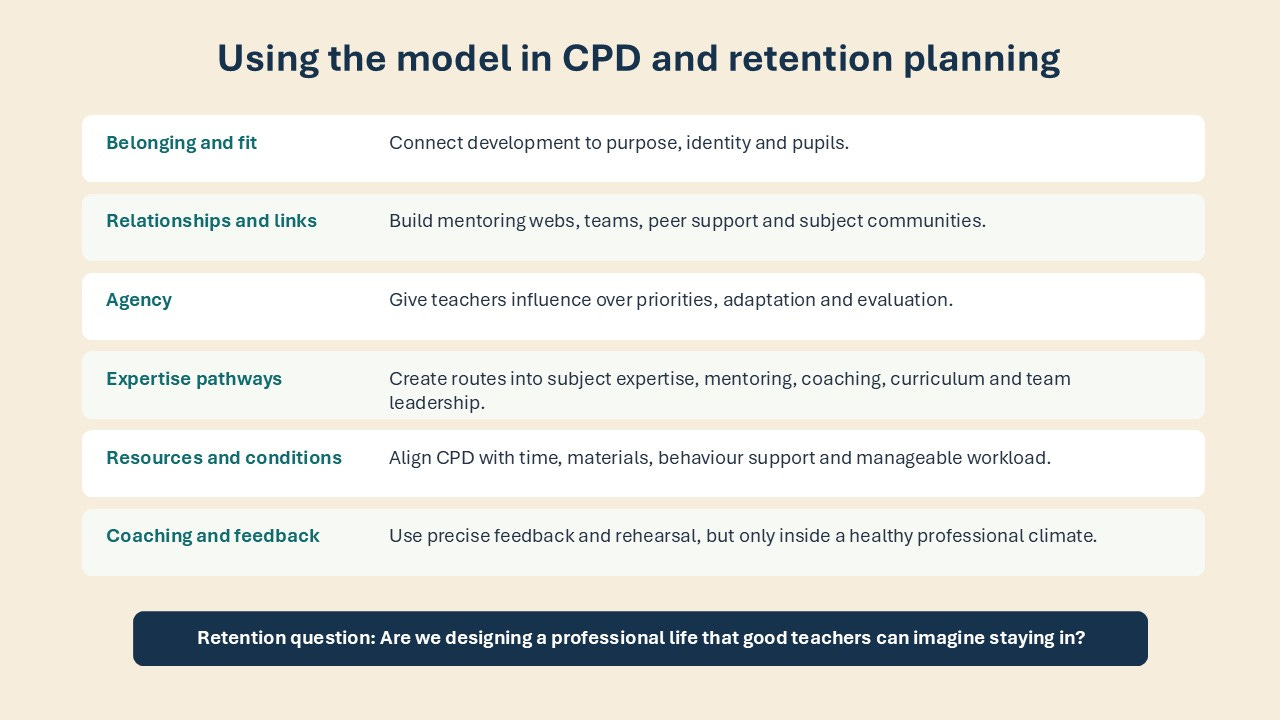
Schools often try to retain teachers by focusing on only one part of the garden. They offer more CPD, but no time. More coaching, but no agency. More wellbeing, but no workload change. More collaboration, but no training in how teams actually work. More leadership opportunities, but only for those willing to leave the classroom or burn out.
A retention-focused model of teacher development asks better questions:
Do teachers belong here?
Are they connected?
Can they shape the work?
Are they becoming more expert?
Do they have meaningful futures?
Are they resourced properly?
Can they keep doing this work well?
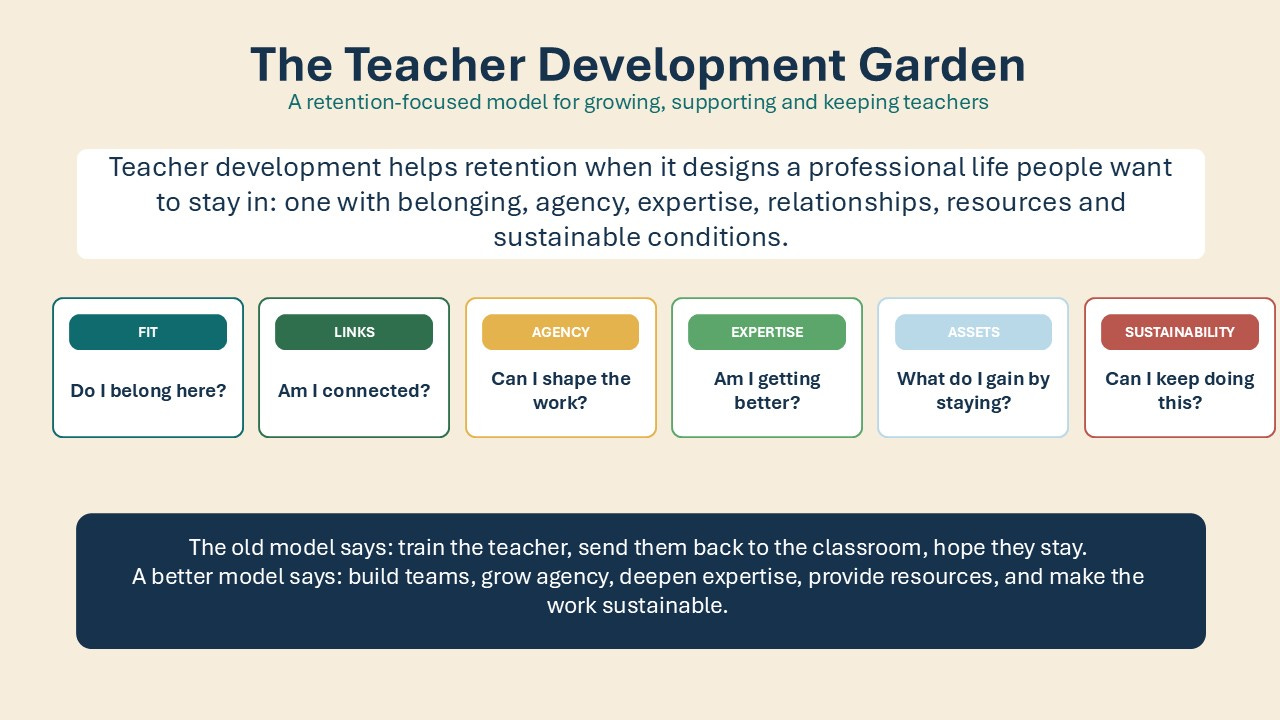
The old model says: train the teacher, send them back to the classroom, hope they stay.
A better model says: build the soil, strengthen the roots, grow the trunk, protect the greenhouse, water the work, prune with care, and watch for the weather.
Teachers stay where they can belong, grow, contribute and do good work sustainably. That is not a CPD programme. It is a professional ecosystem.
🙌 spot on!