The Envelope

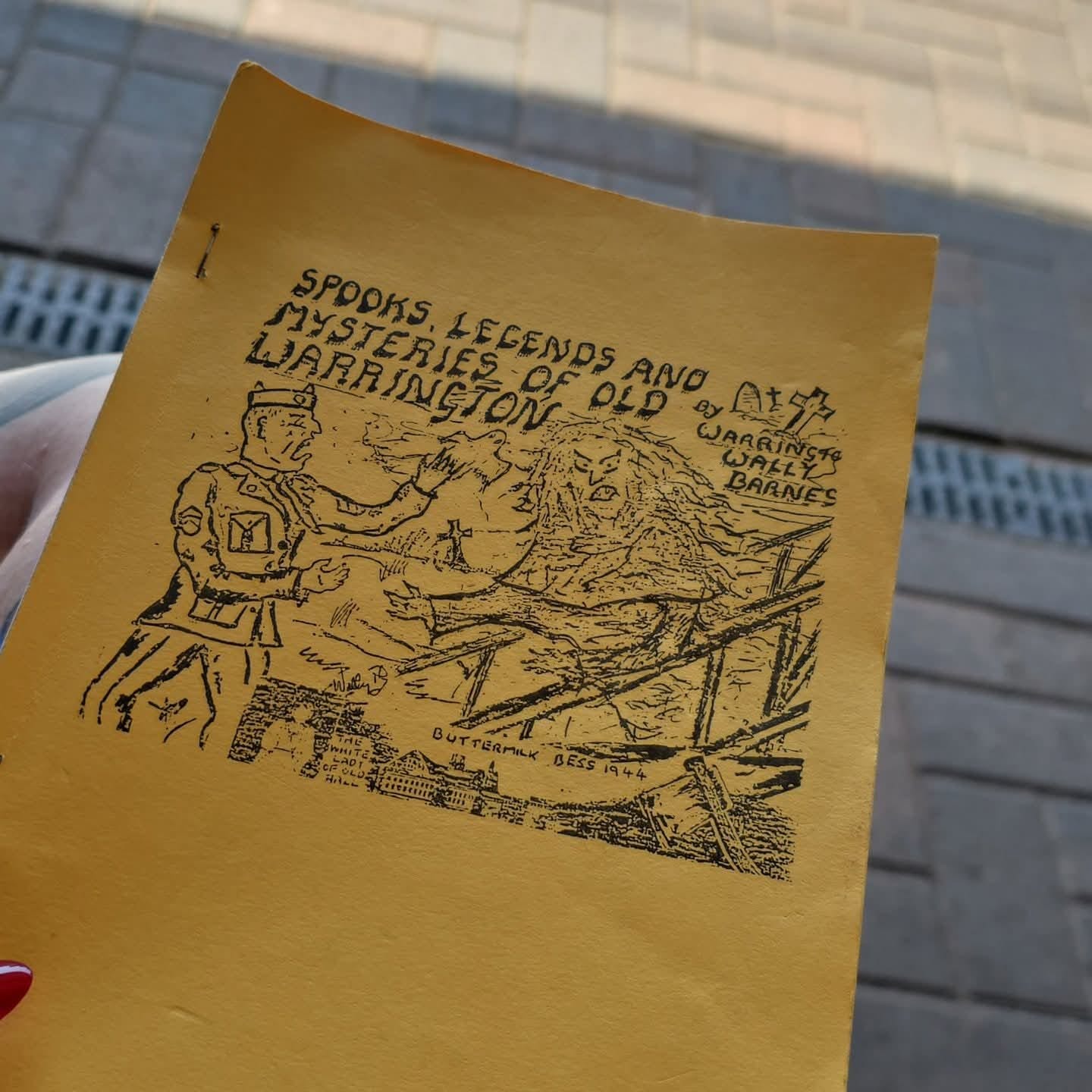
I have been reading the ghost stories of Wally Barnes in Warrington.
As a child in Warrington, I remember a visit from Wally in primary school and was absolutely captivated. In my mid-40s, I have still never forgotten it. The stories are not the polished kind of ghost stories that arrive with jump scares and cinematic fog, but the old local kind, the ones that feel as though someone has leaned across a pub table and said, “You’ll never believe what happened down our way.” They are full of streets you can picture, corners you might have passed, houses with histories, and people whose names seem to carry a whole town behind them.
What struck me most was not the ghosts.
It was the people.
Local characters. Proper ones. The sort every town used to have and every neighbourhood quietly depended on. The woman who knew everybody’s business but would still bring soup if you were ill. The man who stood outside the corner shop in an army uniform, smoking endless roll-ups, for no obvious reason other than that standing outside the corner shop was his vocation. The neighbour who shouted across the street, the child who was sent to borrow sugar, the old boy with a story for every brick in the place.
Wally Barnes writes about ghosts, but what he really preserves is memory. And memory, more often than not, wears a human face.
I found myself wondering where all the local characters have gone.
Perhaps they are still there, but we no longer notice them. Perhaps they sit behind double glazing now, framed by the blue light of a television, while the street outside grows quieter. Perhaps they walk past us in supermarkets while we look down at our phones. Perhaps they have become “that man from number 42” instead of Dave from number 42, who once went arse over tit putting the wheelie bin out in his slippers and laughed so loudly half the close opened their curtains.
We know more people than ever and fewer people properly.
We know what an old school friend had for lunch in Dubai, but not the name of the woman three doors down. We can send a message across the world in seconds, yet hesitate before knocking on a neighbour’s door. We can track parcels, order food, join meetings, bank, shop, date, argue, grieve, and celebrate through screens. The world has never been more connected.
So why does it often feel so lonely?
Technology has made life easier in many ways. It would be dishonest to pretend otherwise. It brings distant families close. As I am about to move to the other side of the world, it brings me comfort to know I will at least see my neices and nephews growing up on my screen. It gives voice to those who might once have been ignored. It helps the housebound, the isolated, the busy, the anxious. It has allowed communities to form around shared interests rather than shared postcodes.
But every convenience asks for something in return.
We used to need each other for small things. A cup of milk. A lift. Directions. A recommendation. A spare chair. A hand moving furniture. A borrowed ladder. Someone to watch the children for five minutes. Someone to say, “I haven’t seen Mrs Jones today, have you?” Now we have apps for all of that.
We do not have to ask. And because we do not have to ask, we do not have to risk awkwardness. We do not have to admit need. We do not have to owe anyone anything. We do not have to become entangled.
Modern life has quietly sold us the fantasy of frictionless living. No queues. No interruptions. No small talk. No bumping into people. No waiting. No being known. But a frictionless life is a lonely one.
Human connection is made in the friction. It happens in the moments we do not schedule. The chat at the bus stop. The nod from the postman. The neighbour who takes the bin out when we forget. The woman in the shop who remembers we like oat milk. The man walking the dog who tells us the weather is turning. The child who waves from a pram. The friend we run into while buying one ordinary thing.
These moments look small from the outside. They do not change policy. They do not trend. They do not announce themselves as meaningful. But they tell us we exist.
A person becomes less invisible when someone says their name. A street becomes less frightening when faces become familiar. A town becomes less anonymous when stories attach themselves to its corners. Fear grows well in places where people do not know one another.
When neighbours are strangers, every noise becomes suspicious. Every teenager on a bike becomes a threat. Every unfamiliar face becomes something to be wary of. We lock our doors, close our curtains, scroll through crime posts online, and tell ourselves the world is worse than it used to be. No wonder we are living in a world torn apart by hate, fear and distrust.
Perhaps in some ways the world is scarier. But perhaps in some ways we have simply stopped knowing the people who might have made it feel safer?
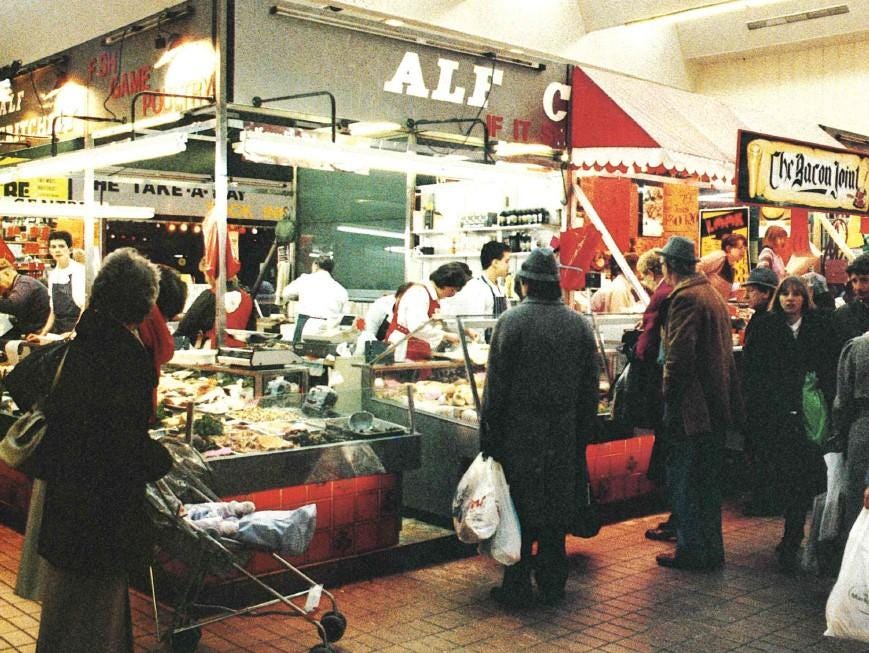
This is a picture of Warrington market, where we did all our shopping. Growing up in a northern town in the 1980s, the past did not feel like history. It was still walking about in a trilby and a good wool coat. Older women wore the sort of dresses and cardigans they must have bought twenty years earlier and kept because they were decent. Their hair in rollers, with a chiffon hair scarf and red lips, as they gossiped with one another on the bus. Old men went into town in suits, not for weddings or funerals, but because they were going into town. My great-grandad only wore jeans in the garden, as though denim belonged with soil, sheds and runner beans, not the high street. At bus stops, old men sometimes gave you a pound for sweets, and nobody filmed it, reported it, or put it on Facebook with a warning about “strange behaviour near children”. They were just local characters then. Known. Placed. Part of the furniture of the town. Now, I suspect, half of them would be photographed from behind, shared in a neighbourhood group, and called weird by people who have lived next door to each other for six years without learning a name.
Of course, community does not remove danger. It does not make everyone kind. It does not turn the world into a postcard. But it gives us witnesses. It gives us small guardianships. It gives us people who notice when the lights have not gone on, when the dog has not been walked, when a child is standing alone too long, when grief has settled over a house.
There is an old wisdom in being known locally. Not famous. Not admired. Just known. The local character was never simply entertainment. They were proof that a place had texture. That people had time for one another. That stories were shared before they were monetised. That eccentricity could survive because someone was around to laugh kindly at it.
I worry that we are becoming too efficient for characters. We curate ourselves now. We edit. We post. We present. We avoid the messy little encounters that make us human because they are inconvenient, unpredictable or slow.
Yesterday, one of the best characters I know, oliver caviglioli shared a story from Kurt Vonnegut one X about buying envelopes and I haven’t been able to stop thinking about it.
“I once told my wife I was going out to buy an envelope:
“Oh,” she said, “well, you’re not a poor man. You know, why don’t you go online and buy a hundred envelopes and put them in the closet?” And so I pretended not to hear her. And went out to get an envelope because I have a hell of a good time in the process of buying one envelope.
I meet a lot of people. And see some great looking babies. And a fire engine goes by. And I give them the thumbs up. And I’ll ask a woman what kind of dog that is. And, and I don’t know.
The moral of the story is – we’re here on Earth to fart around.
Of course, the computers will do us out of that. But what the computer people don’t realise, or they don’t care, is we’re dancing animals. You know, we love to move around. And it’s like we’re not supposed to dance at all anymore.
Let’s all get up and move around a bit right now…or at least dance.”
*************************************************************************************************
We can order a hundred envelopes online and never have to leave the house. But maybe the point was never the envelope. Maybe the point was the walk. The shop bell. The person at the counter. The old man in front counting coins. The baby in the pushchair making a solemn study of your face. The fire engine passing. The dog whose breed you do not know. The brief, ridiculous, blessed interruption of other people.
We are not machines made for perfect output. We are creatures of errands, weather, gossip, laughter, delay, coincidence and touch. We need to be mildly inconvenienced by one another. We need to be pulled out of ourselves.
Wally Barnes’s ghosts haunt Warrington because places remember. Streets remember. Houses remember. Maybe what haunts us now is not the dead, but the living we no longer meet.
I think of all the local characters we have lost, or failed to notice, or replaced with usernames. And I wonder whether the way back is not grand at all. Perhaps it is an envelope. A reason to go out. A reason to speak. A reason to be seen.
Love that story.