When Cognitive Science Becomes a Checklist: The Problem with Generic Lesson Structures

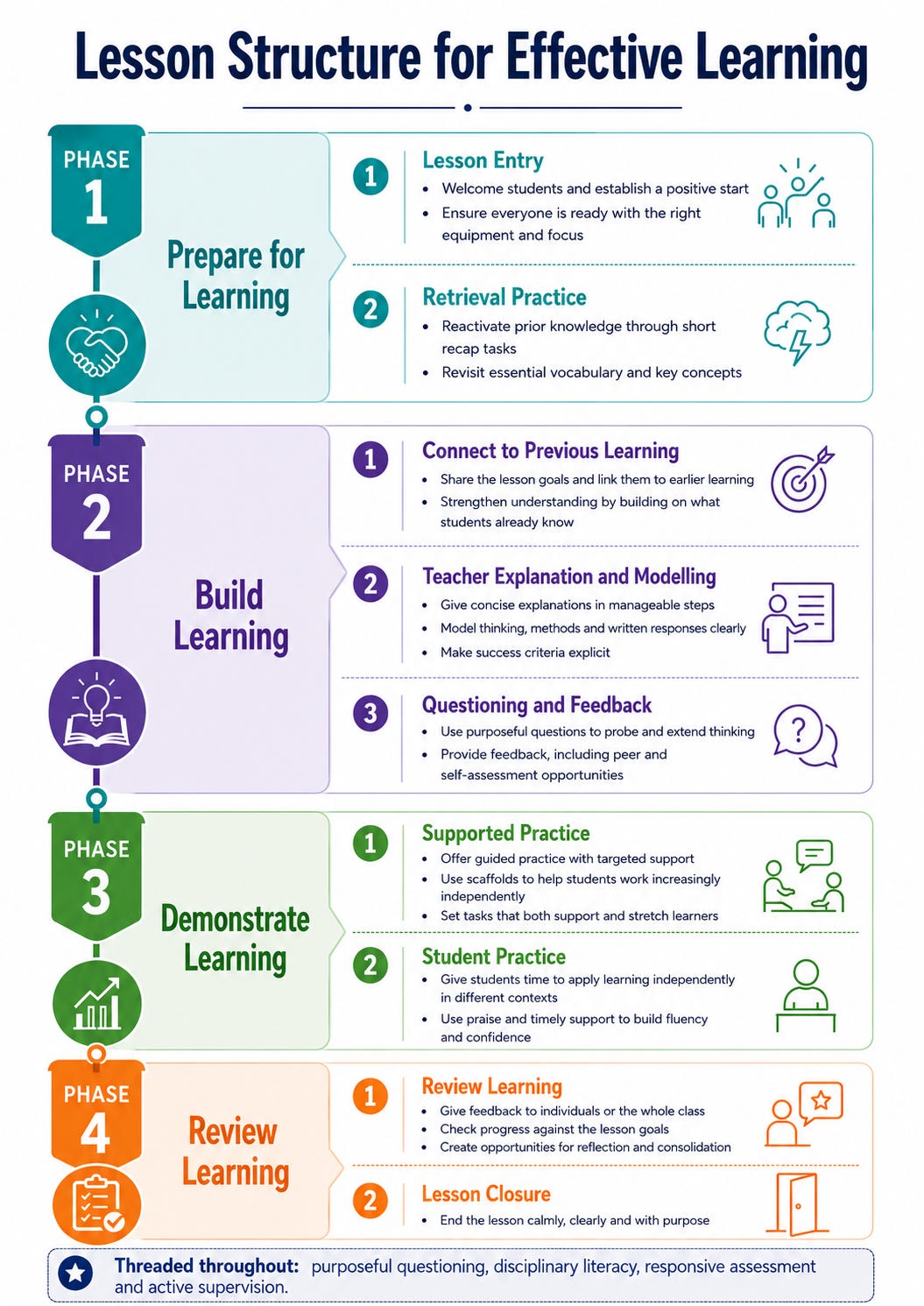
It is easy to see how this kind of lesson structure comes into being. A passionate school leader wants to make a difference. They want consistency, clarity and a shared language for teaching. They may be rightly frustrated by variable classroom practice and want every pupil, in every room, to experience lessons that feel purposeful and well-sequenced. A tight structure appears to offer a solution: it gives staff a common framework, makes expectations visible and seems to translate research into something practical. The intention may be entirely sincere. The difficulty is that good intentions do not guarantee good implementation. When a model designed to improve teaching becomes a required lesson shape, it can quietly reduce the very expertise it was meant to develop.
Of course there is nothing obviously foolish about a lesson structure that includes retrieval practice, teacher explanation, modelling, questioning, feedback, practice and review. In fact, almost every item on the poster has a respectable evidence-informed ancestor. Retrieval practice can support long-term retention. Explicit instruction can reduce unnecessary cognitive burden. Guided practice and feedback matter. Review helps pupils consolidate what they have learned.
The problem is not the ingredients. The problem is the recipe.
When cognitive science is translated into a fixed lesson structure, something important is lost. Research findings become visible rituals. Principles become phases. Professional judgement becomes compliance. This is what we might call a lethal mutation: an idea that began life as a useful insight from research but becomes distorted as it travels into policy, CPD, observation forms or laminated classroom expectations.
Take retrieval practice. Roediger and Karpicke’s work on the testing effect showed that bringing information to mind can strengthen later retention (Roediger & Karpicke, 2006). But this does not mean every lesson should begin with a retrieval starter. Retrieval is useful when it asks pupils to recall relevant knowledge, at an appropriate level of difficulty, at a useful distance from initial teaching, and in a way that supports the learning that follows. A five-question quiz on disconnected facts may look like retrieval practice while doing little to build usable knowledge.
The same problem applies to cognitive load theory. It is easy to write “clear and precise instruction to prevent cognitive overload” on a poster. But cognitive load is not managed simply by having a teacher explanation phase. It depends on the complexity of the material, pupils’ prior knowledge, the sequencing of examples, the removal of irrelevant distractions, the design of tasks and the gradual release of responsibility. Kirschner, Sweller and Clark (2006) argue that novices usually need strong instructional guidance because unguided discovery can overload working memory. That is a powerful principle. It is not a command to place “teacher explanation and modelling” at point two in every lesson.
Rosenshine’s principles are often treated in a similar way. His work summarised practices associated with effective instruction: reviewing prior learning, presenting material in small steps, asking questions, providing models, guiding practice, checking understanding and securing independent practice (Rosenshine, 2012). These are helpful principles for thinking about teaching. They are not a universal lesson script. The danger is that schools turn them into a performance routine: starter, objective, explanation, questions, task, plenary. A lesson can include all of these moves and still produce weak learning.
Learning is not the same as lesson performance. Pupils may appear busy, compliant and successful during a task while retaining little afterwards. They may answer questions correctly because the teacher has over-scaffolded the activity. They may complete independent work without developing transferable understanding. A lesson structure can make teaching look orderly while concealing whether pupils are actually learning the intended content.
The deeper issue for me though is that generic structures are weak proxies for teacher expertise. Expert teaching is not the ability to follow a sequence. It is the ability to make good decisions in context. What exactly are pupils learning? What prior knowledge does this depend on? What misconceptions are likely? Which example will make the concept clearer? Which non-example will sharpen the distinction? When should I model? When should I ask pupils to attempt? When is struggle productive, and when is it a sign that the task has been poorly designed?
These are questions of pedagogical content knowledge. Shulman (1986) argued that teacher knowledge is not just subject knowledge or general pedagogy, but the special capacity to represent particular ideas in ways that learners can grasp. That kind of knowledge cannot be captured by a generic four-phase structure. “Modelling” in algebra, poetry analysis, historical causation, phonics and science practical work means different things. “Questioning” in each subject serves different purposes. “Practice” may mean fluency, interpretation, classification, application, rehearsal, composition or critique.
A generic lesson structure also risks encouraging routine expertise rather than adaptive expertise. Teachers may become skilled at producing the expected shape of a lesson without becoming better at diagnosing learning. They learn to perform the model, not to think more deeply about the instructional problem. The structure becomes the proxy for quality: if the boxes are ticked, the lesson is judged effective.
A possible rationale for imposing a tight structure is that it protects pupils from the weakest teaching in the building. This is understandable, but problematic.
The ECT

For an ECT, a structure may offer useful security at first, but if it becomes the measure of good teaching, it can prevent them from learning how to make principled decisions. They may learn to ask, “Have I included retrieval and modelling?” rather than, “What does this class need to understand this concept?”
The experienced effective teacher

For an experienced, effective teacher, the structure can become a ceiling rather than a floor. It may force them to interrupt a carefully designed sequence, add unnecessary activities, or justify expert decisions that do not match the template. Instead of adapting to what pupils need, they may begin performing the expected lesson shape. A teacher who knows the class needs extended discussion, more modelling, or immediate reteaching may feel pressured to move on because the next phase is due. Over time, this shifts expertise from responsive decision-making to visible compliance: the lesson looks consistent, but the teacher’s professional judgement is constrained.
The struggling teacher

For a struggling teacher, the structure may create the illusion of improvement. They can perform the phases while still choosing poor examples, missing misconceptions, asking superficial questions or setting practice that does not secure learning. In all three cases, the structure substitutes visible compliance for professional growth.
Essentially…nobody wins, but you have a laminated, pretty, dual-coded sheet.
Look, cognitive science should make teaching more intelligent, not more mechanical. It should help teachers think about memory, attention, prior knowledge, working memory, examples, practice and feedback. It should sharpen professional judgement, not replace it. A better lesson planning model would not begin with phases. It would begin with learning and learning problems. What should pupils know or be able to do by the end? Why is this difficult? What do they already know? What will I show them? What will they practise? How will I know whether they understand? What will I do if they do not?
That is less tidy than a poster. But it is much closer to the real work of developing actual evidence informed teacher expertise.
References
Kirschner, P. A., Sweller, J., & Clark, R. E. (2006). Why minimal guidance during instruction does not work: An analysis of the failure of constructivist, discovery, problem-based, experiential, and inquiry-based teaching. Educational Psychologist, 41(2), 75–86.
Roediger, H. L., & Karpicke, J. D. (2006). Test-enhanced learning: Taking memory tests improves long-term retention. Psychological Science, 17(3), 249–255.
Rosenshine, B. (2012). Principles of instruction: Research-based strategies that all teachers should know. American Educator, 36(1), 12–19, 39.
Shulman, L. S. (1986). Those who understand: Knowledge growth in teaching. Educational Researcher, 15(2), 4–14.
Very thoughtful piece. Agree entirely. Very useful ingredients, but the recipe might be different depending on the class or learning problem. I also think it helps to plan for a series of lessons, not reducing lessons to silos. Those five for five retrieval exercises haunt my nightmares.
Is there a place for this structured approach on a school’s journey towards a deeper mature set of T&L principles to be used by expert teachers in well crafted learning that may not fit all features of the ‘standard model’?